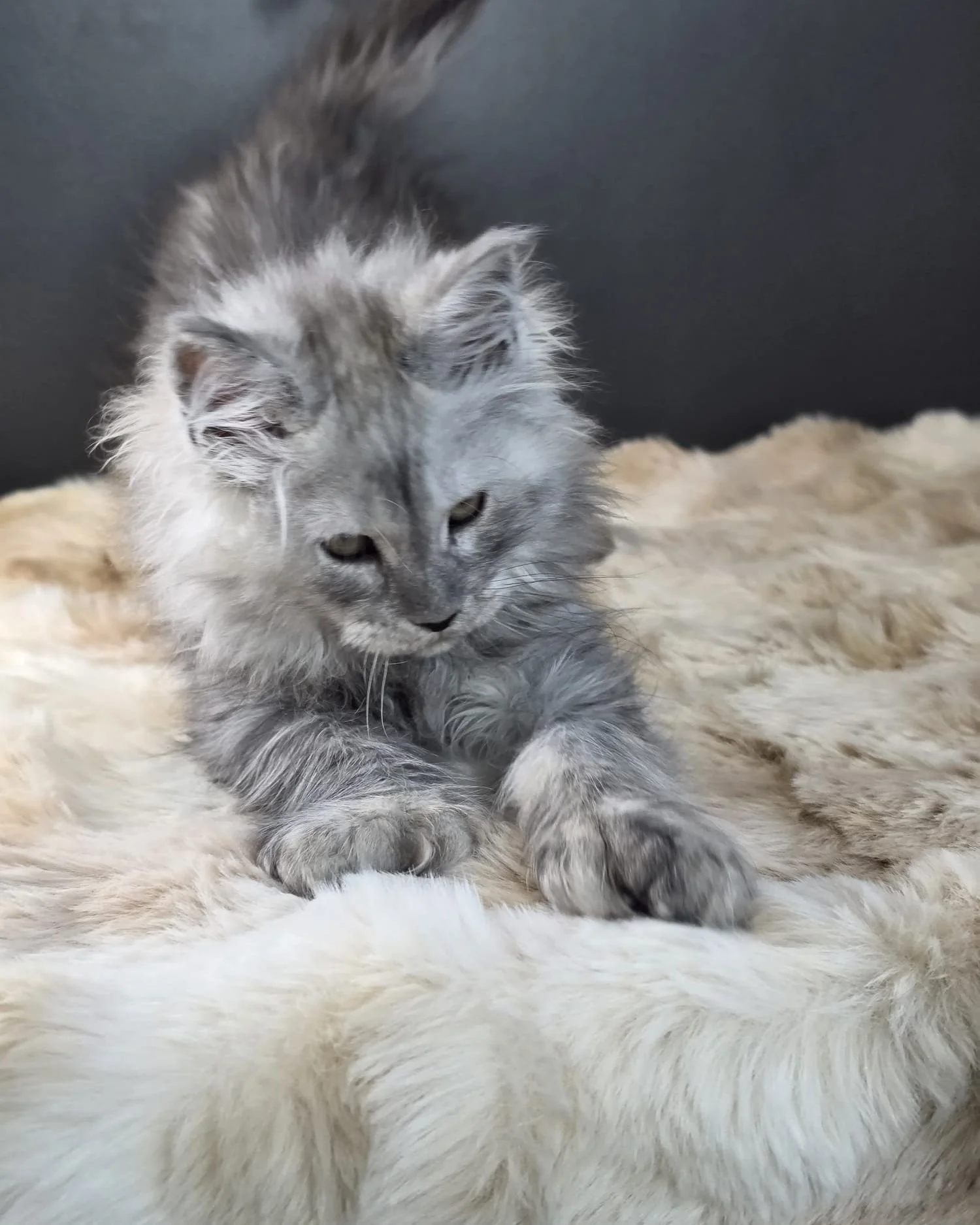
In short: A polydactyl Maine Coon is simply a Maine Coon born with extra toes. It is a natural, inherited trait that has been part of the breed since its early days in snowy New England, and it does not change their size, health or personality. The main difference for you as an owner is a few more claws to trim and, honestly, a lot more paw to love.
What does polydactyl actually mean?
Polydactyl just means "many digits". Most cats have 18 toes, five on each front paw and four on each back paw. A polydactyl cat has more than that, usually on the front paws and sometimes on the back paws too.
The extra toes can show up in a few ways. Some kittens have what looks like a little thumb on the inside of the paw, which is why people call them mitten paws. Others have a wider, rounder paw with an extra toe on the outside, sometimes called a snowshoe paw. Even kittens from the same litter can have different toe counts, so every polydactyl is a little bit unique.
Why Maine Coons are famous for extra toes
The Maine Coon started out as a working farm and ship cat in the cold north east of the United States, and extra toes were common in those early cats. Breed writers have long estimated that as many as 4 in 10 of the early Maine Coons were polydactyl. The popular theory is that big, wide paws helped them walk on snow like natural snowshoes. It is a nice story, and it makes sense when you look at those paws, but nobody has proven it.
When the Maine Coon became a recognised show breed, the breed standards were written around the regular 18 toes, so many breeders stopped breeding polydactyls. That is why they are much less common today. Some breeders kept the trait going, and in 2015 TICA, one of the major cat registries, accepted the Maine Coon Polydactyl for championship showing. Other registries, including the CFA, still do not allow extra toes in the show ring. For a pet at home, none of this matters. A polydactyl Maine Coon is still a Maine Coon.
How the trait is passed on
Polydactyly comes from a natural genetic variation and it is a dominant trait. A kitten only needs one polydactyl parent to have a chance of inheriting it, and when one parent is polydactyl, roughly half the kittens are born with extra toes. The toes do not appear later in life. A kitten is either born with them or not.
Do extra toes cause health problems?
In most cats, no. Polydactyl cats are generally just as healthy and live just as long as cats with regular paws, and the extra toes do not usually slow them down. Purina's guide to polydactyl cats makes the same point and adds the one thing to watch: the claws.
Extra toes sometimes sit at an angle, so their claws do not always wear down when your cat scratches. If they are left too long they can curl, catch on fabric or even grow into the paw pad. That is easy to prevent with regular trims. If a toe ever looks red or swollen, or your cat starts limping, see your vet.
Caring for polydactyl paws in Singapore
Most cats in Singapore live indoors in HDB flats and condos, which means less natural claw wear than an outdoor cat. A few simple habits keep those paws happy:
Check all the claws every week or two, including the extra ones, and trim the tips when they get sharp.
Get your kitten used to having its paws handled early, with treats and short, calm sessions.
Give them a tall, sturdy scratching post and a flat scratcher. Maine Coons are big cats and love a full stretch.
Keep the fur between the toes tidy. Maine Coons grow lovely tufts there, and on big polydactyl paws they can trap litter.
If you are not sure how to trim claws, ask your vet or groomer to show you the first time. After a few goes it takes a couple of minutes.
Polydactyl vs regular Maine Coon: what is the difference?
Only the paws. Polydactyl Maine Coons have the same big frame, shaggy coat, tufted ears and gentle, people loving personality as any other Maine Coon. Some owners say their polydactyls use their paws more like hands, scooping up toys or patting at things, but every cat is an individual.
What to ask before you buy a polydactyl Maine Coon
Which parent is polydactyl? A good breeder knows the trait runs in their lines and can tell you about the parents.
How many toes, and on which paws? Ask for clear photos or a video of all four paws.
Has a vet checked the paws? The toes should be well formed, with no claws growing at an odd angle.
Is the kitten registered, and with whom? Some registries record polydactyl Maine Coons separately, so ask what the paperwork will show.
Is the price different, and why? Some breeders charge more for polydactyls. Make sure you understand what you are paying for.
The usual checks still apply too, from health testing to how the kittens are raised. Our guide to choosing an ethical cattery in Singapore walks through them, and if your kitten is coming from overseas, our imported vs locally bred guide explains what to expect.
Meet our polydactyl Maine Coon
Mr Mitten is a black smoke polydactyl Maine Coon boy, bred in England from strong Russian and European lines and arriving in Singapore in the first week of December. His breeder describes the litter as super loving and a little clingy, and he has been very well socialised with the family. You can see more of our Maine Coons on our Maine Coon page.
Frequently asked questions
Are polydactyl Maine Coons rare?
They are much less common than they used to be, because many breeders bred the trait out after the show standards were written. Not every litter has one.
Do the extra toes hurt?
No. They are a natural part of the paw. Just keep the claws trimmed so they do not curl or snag.
Can a polydactyl Maine Coon be shown?
In TICA shows, yes. Polydactyl Maine Coons have been able to compete for championship there since 2015. Some other registries, such as the CFA, do not allow extra toes in the show ring.
How much is a polydactyl Maine Coon in Singapore?
Our Maine Coon kittens are currently S$7,500 to S$9,000, depending on the kitten. Message us for Mr Mitten's price.
Can I see the paws in person?
Of course. Once he arrives, book a private viewing and you can count the toes yourself.
Ready to meet them?
There is never any pressure. Message us on WhatsApp to ask about Mr Mitten or to book a private viewing once he lands, or see our Maine Coon kittens.

About the author
John is the founder of Fluffydolls Cattery in Singapore. He grew up on a farm surrounded by animals and started out as a breeder before becoming an importer. Today he and Grace work with a small circle of ethical European home breeders to raise healthy, well-socialised pedigree kittens, and they stay involved in every kitten's life long after go-home day.
About Fluffydolls Cattery:
A home-raised pedigree cattery in Singapore (AVS Licence AS22L00066), raising kittens from trusted European breeders for temperament, health and lifelong support.